

A look back at when the world feared the worst
-
On August 2, 1990, the world woke up to a grim headline: “Iraq Invades Kuwait; Oil Prices Soar, Markets Plunge.”
Saddam Hussein's forces had crossed into Kuwait, triggering fears of a prolonged conflict in the oil-rich Middle East.
The immediate market reaction was swift and severe:
Oil prices surged more than 30% within a few days
The S&P 500 fell more than -10% in the weeks that followed
Headlines warned of war, energy shortages, and global recession
For investors at the time, the situation felt dire. Geopolitical tension combined with economic uncertainty - an environment ripe for panic selling. Markets, driven by fear and speculation, did what they often do in moments of crisis… they fell sharply in the short term.
But what happened next tells a very different story.
The conflict resolved more quickly than many anticipated, and markets rebounded strongly. The Gulf War became one of many examples in which initial market reactions to Middle East conflict gave way to recovery and continued long-term growth.
S&P 500 performance after the Gulf War began1
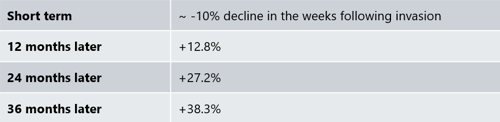
The key takeaway here was not that conflict has no impact, it clearly does. It was that investors who stayed disciplined were rewarded over time.
A broader pattern of resilience amid conflict
The Gulf War was not unique.
Since 1980, the Middle East has seen repeated episodes of conflict, each accompanied by alarming headlines and short-term volatility.
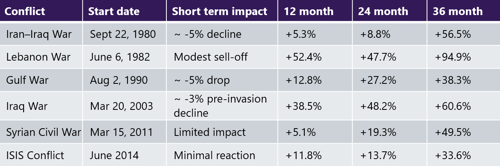
Across four decades, the pattern is strikingly consistent:
Initial shock: Markets react negatively as uncertainty spikes
Stabilisation: As facts replace fear, volatility eases
Recovery and growth: Markets resume their longer-term upward trajectory
Even in cases where conflicts persisted for years, markets did not remain permanently impaired.
Why markets tend to recover
Geopolitical events feel existential in the moment. The news flow is intense and worst-case scenarios dominate commentary.
But markets price in expectations rapidly. Once the range of potential outcomes is assessed and reflected in prices, investors begin focusing again on the fundamentals like corporate earnings, economic growth, monetary policy, innovation and productivity.
Unless a conflict fundamentally disrupts the global economic system, history shows markets adapt. Energy shocks can cause temporary inflationary pressure, but diversified global companies adjust, supply chains reroute, policy responds and economic activity continues.
What this means for New Zealand investors
Whether investing through KiwiSaver, or through a diversified strategy with an adviser, international headlines can feel unsettling. As New Zealanders, we are geographically distant but financially connected.
A few important reminders:
Short-term volatility is normal
Market dips during geopolitical stress are expected. They are not evidence that long-term investing has stopped working.
The long-term record is strong
Across nearly every major Middle East conflict in modern market history, investors who stayed invested were better off 12, 24, and 36 months later.
Diversification is your shock absorber
Well-constructed portfolios spread risk across regions, industries, asset classes and currencies. This diversification reduces reliance on any one outcome.
New Zealand’s relative insulation
New Zealand’s economy, supported by agriculture, domestic services, and Asia-Pacific trade, has historically been less directly exposed to Middle Eastern conflict than major oil-importing economies. While global growth matters, we are not on the front line of geopolitical risk.
Bringing it back to today
The recent escalation involving Iran understandably raises concerns about oil supply, inflation and regional stability. Markets may remain volatile in the short term and oil prices may fluctuate, but this environment fits a historical pattern rather than breaking it.
Over the past 40+ years, markets have navigated oil embargoes, Gulf wars, terrorism, regional uprisings, prolonged Middle East instability and yet long-term global equity returns have remained positive and substantial.
Discipline over drama
The lesson of the Gulf War, and nearly every major Middle East conflict since, is not that markets ignore risk. They do not.
It is that markets absorb shocks and move forward.
While today’s headlines surrounding Israel, Iran, and US involvement may feel uniquely alarming, history argues against emotional decision-making. Attempting to time exits during geopolitical stress has consistently proven more damaging than remaining invested.
For New Zealand investors, the most powerful strategy remains:
Stay diversified
Stay disciplined
Stay focused on long-term goals
Remember, time in the market continues to beat timing the market.
1 All return calculations, including those in the conflict summary table that follows, are based on monthly returns of the S&P 500 Index (total return) and include the return of the month the conflict commenced.
The information contained in this article is intended to be of a general nature. It does not take into account the objectives, financial situation or needs of any particular person, and does not constitute financial advice. Consilium NZ Limited is the issuer of the Evidential KiwiSaver Scheme. For more information on Evidential KiwiSaver Scheme including a copy of the Product Disclosure Statement, visit www.evidential.co.nz