

Governments change. Good investing doesn’t.
-
Every election seems to come with a familiar soundtrack.
There are headlines about what might happen next. Forecasts about winners and losers. Bold promises, strong opinions and no shortage of people telling you exactly what the future holds.
KiwiSaver often finds itself pulled into those conversations.
That’s understandable. For many New Zealanders, KiwiSaver is one of their largest financial assets outside their family home. When politicians start talking about contribution rates, government incentives or retirement policy, people naturally pay attention.
The challenge is working out what actually matters for your long term savings.
The parts of KiwiSaver politicians can influence
Governments can influence KiwiSaver in several ways. They can adjust contribution settings, change government incentives, alter withdrawal rules or modify tax settings. Election campaigns often include ideas in one or more of these areas, and this election is no different, with proposals relating to KiwiSaver contributions, participation and tax settings.
Of course, election promises are not the same as policy. Any proposed changes would still need to progress through the normal legislative process before becoming part of the KiwiSaver rules that apply to members day to day.
For KiwiSaver members, policy changes can matter. A higher contribution rate may increase the amount being saved over time. Changes to incentives or withdrawal rules may affect how people use the scheme. These are practical considerations and worth understanding.
But they are only one piece of the puzzle.The bigger story is often behaviour
It’s easy to look at a proposed policy and immediately calculate what it could add to, or subtract from, a future KiwiSaver balance. Yet other factors may have a greater influence on long term outcomes, such as how much you save, how long you remain invested, the investment strategy you choose and the decisions you make during periods of uncertainty.
History provides a useful reminder here. KiwiSaver has changed considerably since it was introduced in 2007. Different governments have adjusted incentives, contribution settings and other scheme features along the way.
The history of KiwiSaver
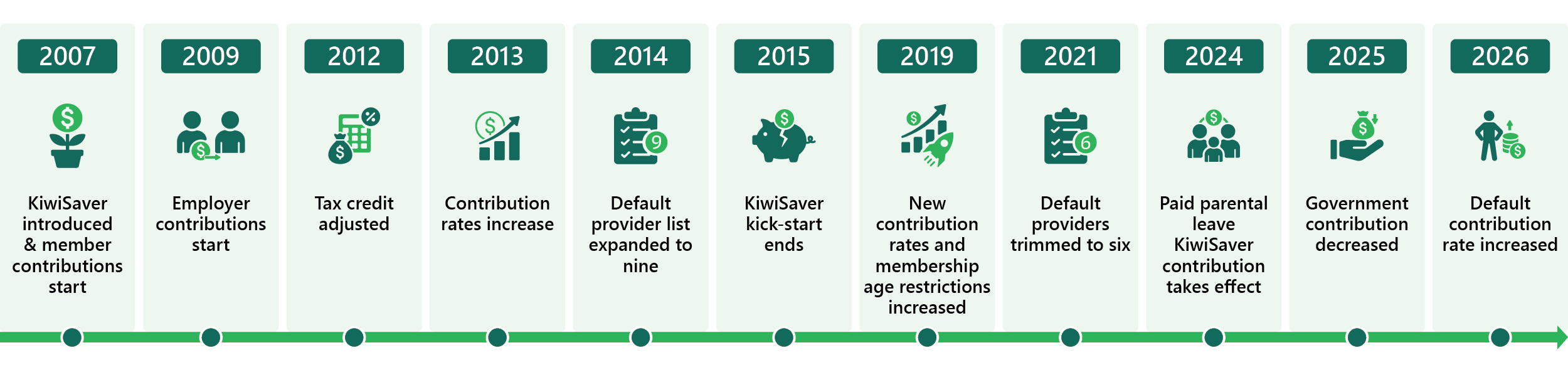
Some of those changes have had a meaningful impact on members, but successful long term investing has never depended on policy settings remaining the same forever. Investors have always had to adapt to changing rules, economies and circumstances.
While most of us would struggle to recall every political debate from a decade ago, the savings and investment decisions made during that time may still be affecting our financial position today.
That’s one reason evidence-based investing places so much emphasis on long term behaviour rather than short term prediction.
Policy changes are not market changes
It’s also worth drawing a distinction that can sometimes get lost during election campaigns.
Changes to KiwiSaver rules are not the same thing as changes to investment markets.
A government can change contribution settings, incentives or eligibility rules through legislation. Investment markets are influenced by a much wider set of forces, including economic growth, inflation, interest rates, company earnings, innovation and global events.
Investors may wonder which election outcome will be best for markets. History suggests that’s a difficult question to answer. Markets have experienced periods of both growth and decline under governments of different colours, and investment returns have not followed a simple political pattern. Long term market outcomes are shaped by many factors, most of which extend well beyond a single election result.
Financial markets reflect the expectations of millions of investors, businesses and institutions around the world. That makes it extremely difficult to predict how a particular result might affect future returns, even when the outcome seems obvious in hindsight.
Uncertainty isn’t unique to election years
While political outcomes may be uncertain, investors still have plenty they can influence:
- Review whether your investment strategy suits your goals
- Maintain a diversified portfolio
- Avoid reacting to short term headlines
- Contribute at a level that makes sense for your circumstances
- Keep sight of what you’re investing for in the first place
That’s not to suggest policy changes should be ignored. They should be understood. If KiwiSaver settings change, members can respond thoughtfully based on the facts rather than treating every election headline as a reason to rethink a long term investment plan.
After all, elections and investing operate on very different timelines. Election campaigns last a few months.
Governments serve terms of a few years. Retirement savings are often built over decades.
What remains in your hands
While every investor’s circumstances are different, the principles underpinning evidence-based investing remain relatively consistent:
- Broad diversification
- Cost-effective investing
- Disciplined saving
- Decisions based on evidence rather than short term headlines.
Elections come and go. Governments change. Policies evolve.
But successful investing doesn’t rely on getting every political prediction right. More often, it is built on something far less exciting and far more dependable - staying diversified, staying disciplined and staying invested for the long term.
The information contained in this article is intended to be of a general nature. It does not take into account the objectives, financial situation or needs of any particular person, and does not constitute financial advice. Consilium NZ Limited is the issuer of the Evidential KiwiSaver Scheme. For more information on Evidential KiwiSaver Scheme including a copy of the Product Disclosure Statement, visit www.evidential.co.nz